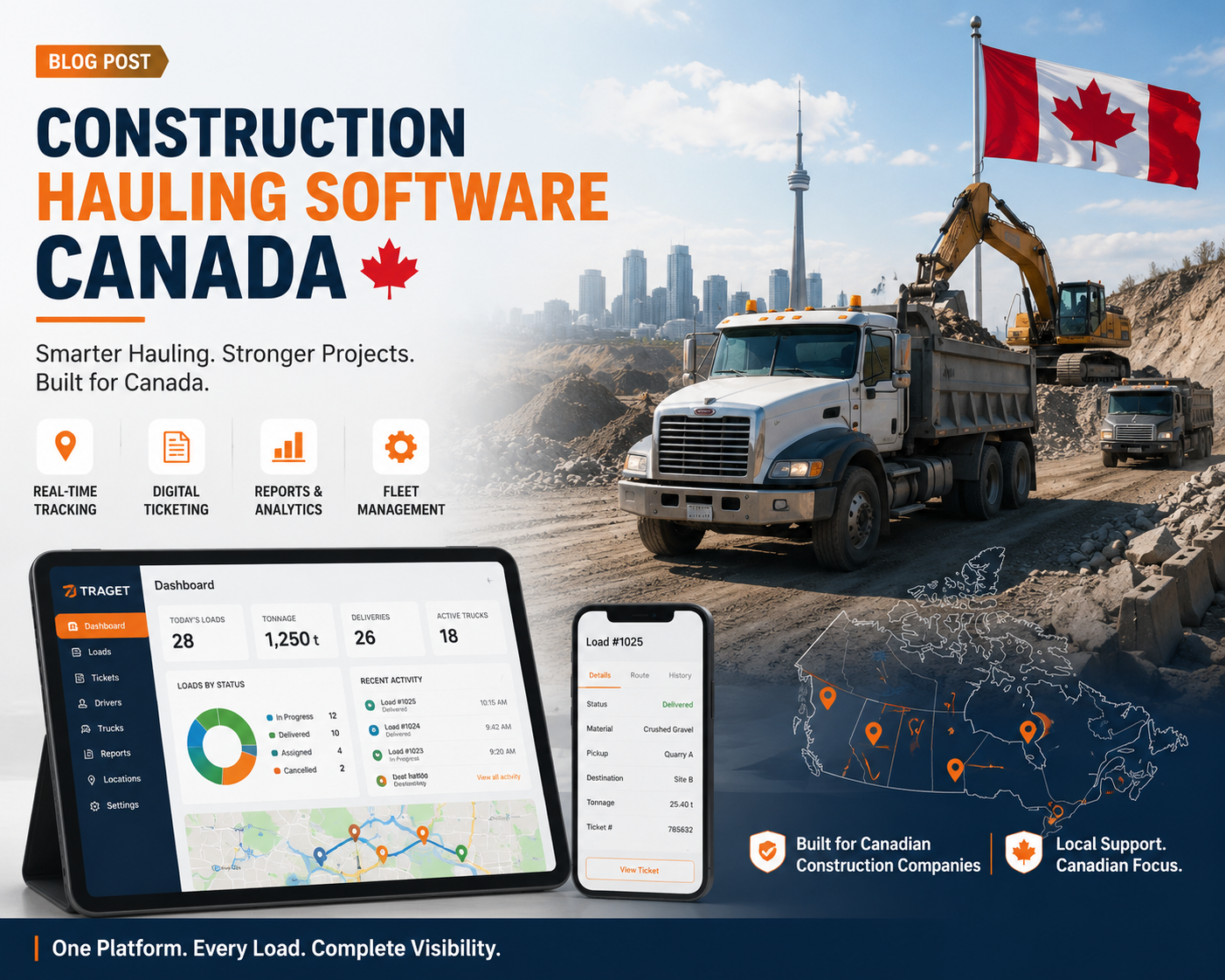
The search term construction hauling software Canada captures something real: Canadian contractors — especially in BC — have specific needs that generic fleet software does not address. They need tools built for short-haul earthworks, aggregate moves, and the complex multi-party relationships between job sites, brokers, owner-operators, and drivers. In 2026, a digital shift is underway, and BC is where it is most visible.
Why Canadian construction hauling is a distinct market
Construction hauling in Canada sits at the intersection of construction management and transportation logistics — but it shares the pain points of neither cleanly. GC firms treat dump trucks as a cost line they want to minimize and automate. Trucking operators treat their trucks as capital assets that need to be productive every hour.
The friction lives in the middle: dispatch communication, load verification, ticket management, and invoicing. In BC specifically, this friction is amplified by the scale of the market — thousands of owner-operators and small fleets doing hyperlocal hauls across the Lower Mainland and Fraser Valley, working with dozens of brokers and hundreds of job sites.
Until recently, this market ran entirely on phone calls and paper tickets. That is changing.
What the digital shift looks like in BC in 2026
The shift to construction hauling software in BC has not happened all at once. It is being driven by three forces converging at the same time:
GC pressure. Larger general contractors in the Lower Mainland are increasingly requiring digital ticketing and audit trails from their hauling subcontractors. Paper tickets do not provide the load-by-load documentation these firms need for project accounting and compliance. Trucking operators who cannot provide digital records are losing contracts to those who can.
Driver shortage economics. With fewer available drivers, BC operators cannot afford idle trucks. Construction hauling software that reduces dispatch gaps and optimizes load scheduling has a direct and measurable ROI when trucks cost 20+/hour to operate.
Cash flow pressure. Small hauling operators in BC — the typical 2-10 truck fleet — run on thin margins. The gap between completing a haul and receiving payment has historically been 30-60 days, driven by paper ticket reconciliation delays. Platforms that enable same-day digital invoicing are compressing that cycle significantly.
What makes good construction hauling software for Canadian operators
There are generic fleet management platforms, TMS solutions built for long-haul carriers, and enterprise dispatch systems designed for large fleets. None of these are purpose-built for BC's construction hauling market. The requirements are different:
Local partner networks. A hauling software platform is only useful if there are active, verified operators already on it. For BC contractors, that means a real network of Lower Mainland and Fraser Valley trucks — not a national directory padded with inactive listings.
Digital ticketing as a core feature. Not an add-on — the core loop. Every load needs a timestamped digital ticket that the contractor, broker, operator, and driver can all see.. Paper ticket reconciliation at month-end is the problem; eliminating it is the goal.
Broker support. Much of BC's hauling market runs through brokers who sit between job sites and owner-operators. Software that handles this three-party relationship — with job visibility and ticket data flowing to all parties — is fundamentally different from direct-dispatch-only platforms.
Mobile-first for drivers. The platform is only as good as driver adoption. A driver app that works on a phone, loads quickly on LTE, and requires minimal training is non-negotiable for BC's owner-operator market.
The BC advantage: local density creates network value
One pattern that distinguishes effective construction hauling software from generic fleet tools: network density matters more than features. A platform where 50 Fraser Valley trucking operators are already active provides more immediate value than a feature-rich platform with no local network.
This is why BC-specific adoption is accelerating faster than the national average. Once a cluster of sites and operators in a region start using the same platform, the value compounds quickly — faster truck sourcing, shorter dispatch gaps, more digital tickets, fewer disputes.
Getting started with digital hauling dispatch in BC
For BC contractors evaluating construction hauling software, the most important first question is not about features — it is about the network. Ask the platform: how many verified trucking operators are active in the Lower Mainland and Fraser Valley right now?
Tragget is built for BC's construction hauling market. The platform connects job sites with verified local trucking partners, replaces paper tickets with timestamped digital records, and auto-generates invoices as hauls are completed. Brokers, operators, and job sites all use the same platform. A 30-day free trial is available.