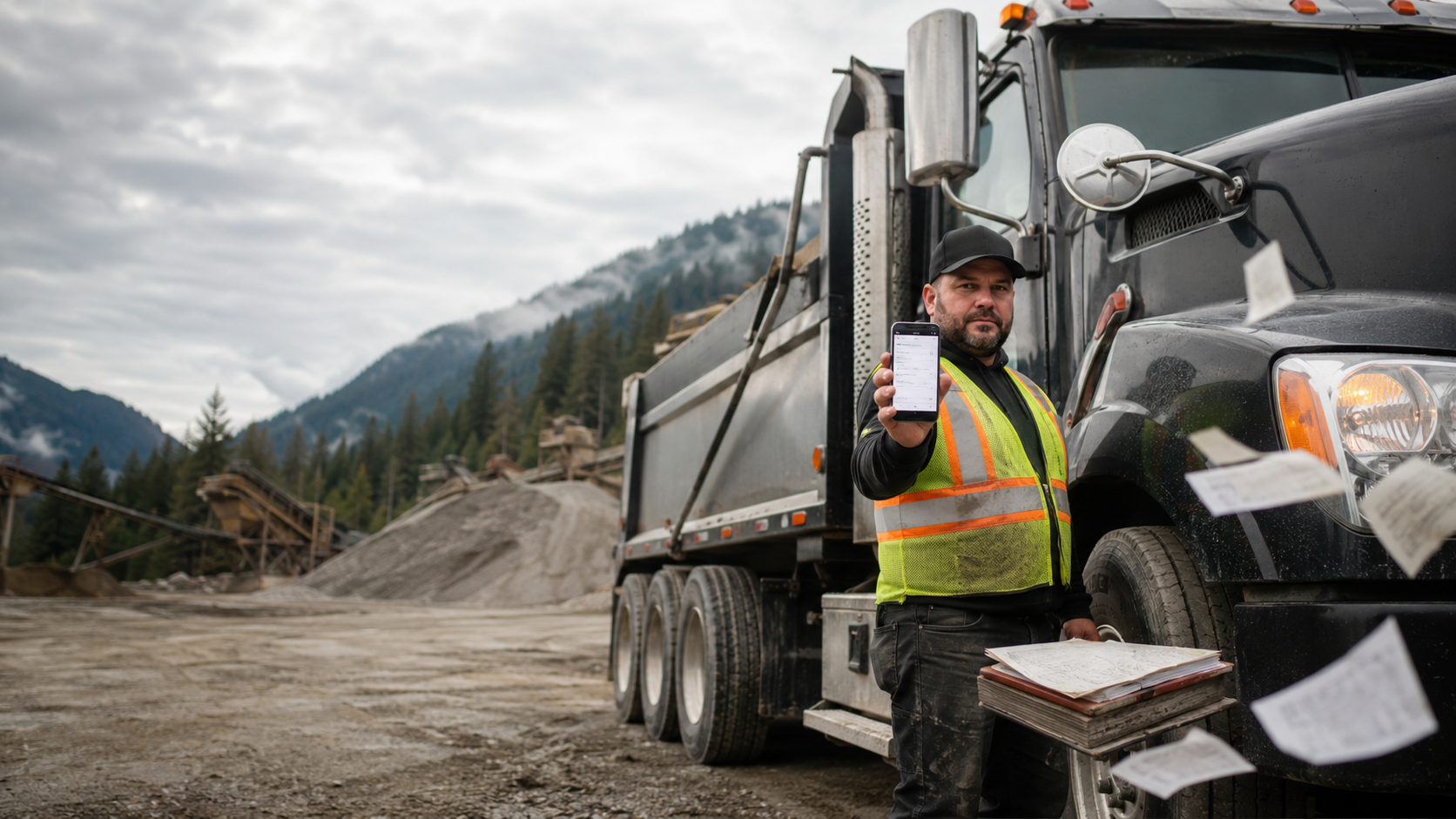
Ask a dump truck operator who "owns" a ticket and most will say the driver, or the foreman who signs it, or whoever still has the carbon copy at the end of the month. The honest answer is usually: nobody does. A paper ticket passes through four or five hands between the moment a load leaves the pit and the moment it shows up on an invoice, and at every handoff it can be lost, smudged, left in a truck door pocket, or simply forgotten. When that happens, the load still happened — the fuel was burned, the material moved — but the record of it didn't survive. That's not a paperwork problem. That's a lost-revenue problem wearing a paperwork costume.
The paper ticket was never really yours
A ticket book that lives in a truck cab, a site trailer, or a stack on someone's desk is only as reliable as the weakest link in that chain. If a GC's site super loses the carbon copy, you're arguing from memory. If a broker's admin "can't find" a ticket at invoicing time, you're the one absorbing the load. You did the work, but you don't control the evidence that you did it — and in a dispute, whoever controls the evidence controls the outcome.
Owning your tickets means flipping that. The record of a load should belong to the operator who hauled it, from the second it happens, not to whichever piece of paper survives the day.
What "owning your tickets" looks like in practice
In a digital ticket book, every load moves through the same lifecycle, and you hold it at every step:
- Created — the driver logs the load from their phone the moment it happens, on-site, with a timestamp that isn't up for debate later.
- Submitted — the ticket goes to the site contact or broker for sign-off, still tied to your record, not sitting in someone else's glovebox.
- Accepted — both sides agree the load happened as logged, while the details are fresh, not three weeks later at reconciliation.
- Approved — the ticket is locked in and ready to invoice, with a full paper trail behind it if anyone ever asks.
None of those steps require the other party to install anything or "join" your system — you can run the whole chain yourself, starting today, and still hand over a clean, agreed-upon record when it's time to bill.
Why this matters more than it sounds like it should
Every operator has a version of the same story: a broker disputes a load count at month-end, and the only proof you have is a memory of "I know we hauled that many." A worked example, using round numbers an operator can swap for their own: at 125 loads a month, if even a handful of tickets go missing or get contested before invoicing, that's real, avoidable revenue sitting on the table — on top of the hours a bookkeeper spends chasing down paper that should never have needed chasing. Owning your tickets from the moment a load happens is what closes that gap. It's also what lets you invoice the same day a job wraps instead of waiting on a stack of paper to make its way back to the office.
You don't need anyone else on board to start
This is the part that surprises people: owning your tickets doesn't require the GC, the broker, or anyone you haul for to sign up for anything or change how they operate. You log your own loads, you hold your own record, and you invoice off it. Nobody you work with has to be on the platform for your ticket book to be yours.
Paper tickets get lost. Digital ones, logged the moment the work happens, don't — and the operator who owns that record is the one who gets paid for exactly what they hauled.