
Turning paper chaos into digital clarity — one truck ticket at a time.
Like many great ideas, Tragget was born out of frustration. Day after day, we watched construction teams, drivers, and dispatchers waste precious hours chasing paper tickets — deciphering handwriting, matching jobs, chasing approvals, and fixing billing errors. Trucking companies were losing time and money to manual coordination and lost communication. We knew there had to be a better way.
That led us to a simple but powerful insight: the truck ticket isn't just paperwork — it's the heartbeat of every dump trucking operation. By digitizing it, we could connect construction sites, brokers, and drivers in real time, eliminate costly errors, and create a smoother, smarter way to move projects forward.
That's how Tragget began — a mission to turn one of the industry's biggest headaches into its most powerful advantage.


We're here to create a transparent, connected, and efficient hauling network — where every truckload, every approval, and every dollar is tracked in one place.
We believe in fairness, clarity, and technology that just works.
Three reasons an operation pays for software at all — and the three things we set out to fix when we started. Everything on this site comes back to one of them.
Money
Nobody sends an invoice for the paper ticket, which is why it looks like it costs nothing. Counted properly — the bookkeeping, the re-keying, the loads that never turn up — it runs about $9.50. On Tragget it is about $1.15. Across 125 loads a month that is roughly $1,044 out of money you are already spending.
Put your own numbers in →Time
The work was finished weeks ago; the invoice waits on somebody assembling paper. Because the ticket is digital from the moment the driver closes the round, the invoice is built and ready to download the day the job is approved. On $112,500 of monthly work, billing about 30 days sooner is worth roughly $647 a month on its own.
Status
The site, the trucking company and the driver used to keep three versions of the same day and argue about the difference at month end. One ticket, visible to all three as it happens, is the whole idea — and it is why we think the truck ticket, not the invoice, is the thing worth digitising first.
Watch one ticket go through →Three jobs the product does — and who each one is for.

For excavating companies
Set the project up once — which trucks, which drivers, what is moving — and every ticket logged against it lands back on that plan while the day is still changeable.
Per project. There is no fleet-wide control tower behind this.
See the planning screens →
For bettering the business
Invoices assemble themselves out of approved tickets on each customer's billing cycle, and the profit and loss underneath is priced off the rounds your drivers actually closed — not a spreadsheet somebody rebuilds at month end.
It also shows what it cannot see yet: work finished but not billed. Sending the invoice is still your click.
See the invoicing and the P&L →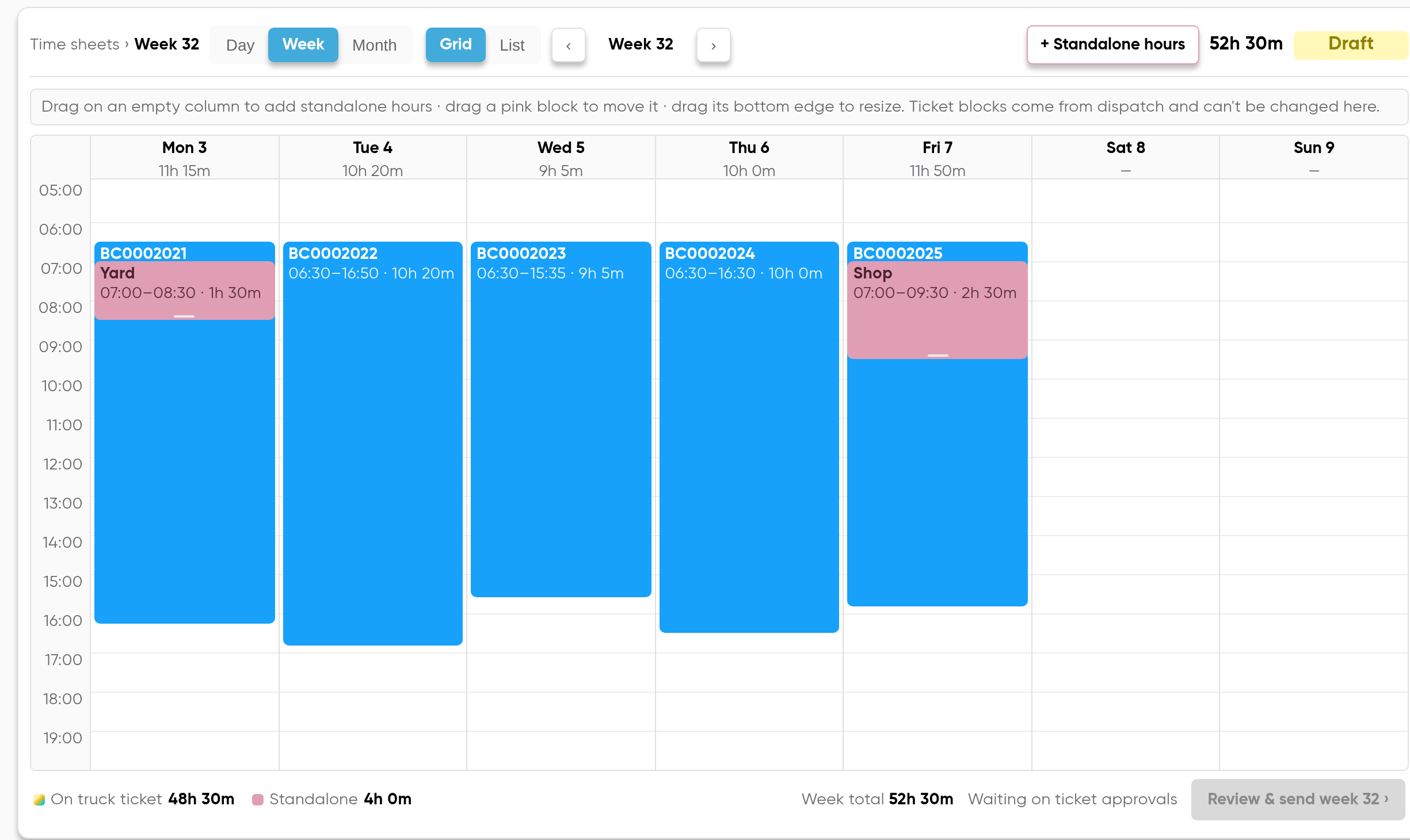
For drivers, and the companies they drive for
Drivers write their rounds and their hours down from the phone as they work them; you review and approve. What comes out is a clean, agreed set of hours — and an owner-operator turns that same record into a proper invoice in their own name.
Tragget is not a payroll service. It is what you hand payroll instead of the shoebox. The invoicing half is for freelance drivers only.
See the driver screens →One platform, one ticket — everyone reading the same day.
If you're as passionate about modernizing the dump truck industry as we are, we'd love to hear from you. Reach out to us to learn more about our solutions and how we can work together to drive positive change.


Fill in the details to send us a message